
Generative AI vs Traditional AI has become an important part of modern technology. From search engines and recommendation systems to chatbots and content creation tools, AI is being used in many areas. Two commonly discussed concepts are **Traditional AI** and **Generative AI**. Although both use artificial intelligence techniques, their purpose and working methods are different. Understanding this difference can help beginners choose the right AI approach for different tasks.
What is Traditional AI?
Traditional AI is mainly designed to analyze information, identify patterns, make predictions, and support decision-making. It generally works with existing data and follows predefined rules, algorithms, or trained models to produce an expected result.
For example, a traditional AI system can identify whether an email is spam, predict customer behavior, recommend a product, or detect unusual activity in a transaction. The system focuses on analyzing available information rather than creating completely new content.
What is Generative AI?
Generative AI is an advanced form of artificial intelligence that learns from existing information and uses that knowledge to create new content such as text, images, videos, audio, and code.
Tools based on Generative AI can help users write articles, create ideas, summarize information, generate images, develop code, and perform many creative tasks. Instead of simply classifying or predicting information, Generative AI can produce new outputs based on the instructions given by the user.
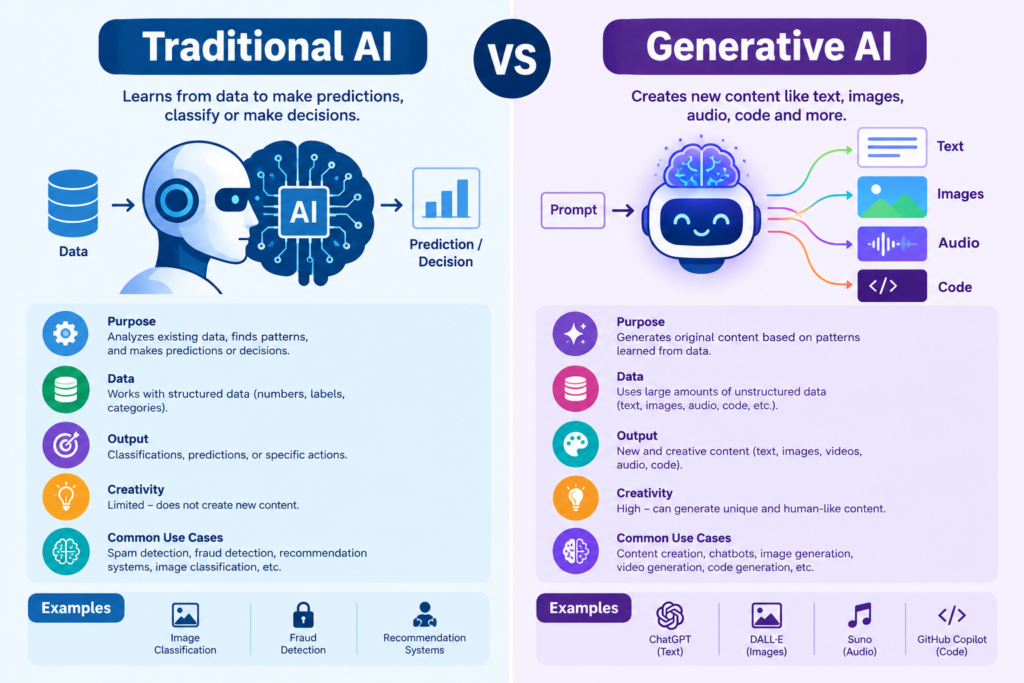
Key Difference Between Generative AI and Traditional AI
The major difference is their **purpose**. Traditional AI is commonly used for analyzing data, predicting outcomes, classifying information, and making decisions. Generative AI vs Traditional AI focuses on producing new content.
For example, a traditional AI system may determine whether a customer is likely to purchase a product. A Generative AI system could create a personalized product description or marketing message for that customer.
Generative AI vs Traditional AI: How Do They Work?
Traditional AI systems are usually trained to perform a specific task. They analyze input data and provide an output according to the patterns or rules learned during training.
Generative AI vs Traditional AI models are trained using large amounts of data to understand patterns, relationships, language, images, or other information. When a user provides a prompt, the model uses what it has learned to generate a new response.
Applications of Traditional AI
Traditional AI is widely used in different industries. Some common applications include:
* Spam email detection
* Fraud detection
* Product recommendations
* Customer behavior prediction
* Image classification
* Credit risk assessment
* Predictive maintenance
* Search and ranking systems
These applications mainly focus on analyzing existing information and producing predictions or decisions.
Applications of Generative AI
Generative AI has introduced new possibilities for businesses and individuals. Common applications include:
* Content and blog writing
* Image generation
* Code generation
* Chatbots and virtual assistants
* Video and audio creation
* Marketing content creation
* Document summarization
* Idea and concept generation
This makes Generative AI especially useful for creative, communication, and productivity-related tasks.
Generative AI vs Traditional AI: Which One is Better?
There is no single answer because both technologies are useful for different purposes. Traditional AI can be more suitable when the goal is classification, prediction, detection, or decision-making. Generative AI vs Traditional AI can be useful when the requirement involves creating new content or interacting with users through natural language.
In many real-world applications, businesses can use both approaches together. For example, Traditional AI can analyze customer data, while Generative AI can use the insights to create personalized communication.
Why Learn Generative AI?
Generative AI vs Traditional AI the growing use of AI tools has increased the importance of understanding Generative AI. Learning the basics of Generative AI can help students and professionals understand its practical uses in fields such as software development, digital marketing, content creation, and data analysis, and business operations.
Conclusion
Generative AI and Traditional AI are both important technologies, but they solve problems in different ways. Traditional AI mainly focuses on **analyzing, predicting, classifying, and making decisions**, while Generative AI focuses on **creating new content from learned patterns**. As AI continues to develop, understanding both approaches can help learners and businesses make better use of artificial intelligence in practical situations.