
Full Stack Python demand for web applications is increasing as businesses move more of their services online. From shopping and banking to education and booking platforms, almost every industry depends on websites and software applications. This has created many opportunities for people who want to build a career in software development.
Full Stack Python Development is a practical way to learn how complete web applications are created. Instead of focusing only on one part of a website, full stack development covers the user interface, server-side programming, databases, and communication between different parts of an application.
Full Stack Python makes this learning journey easier for beginners because its syntax is clean and readable. At the same time, it provides powerful frameworks and libraries that developers can use for professional projects.
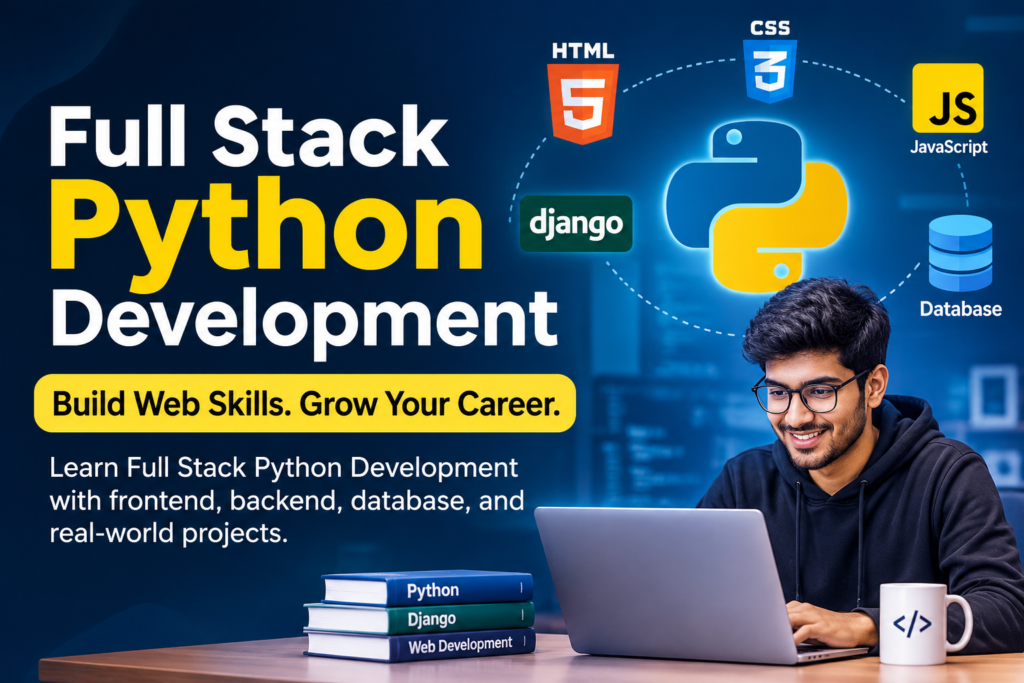
What Does a Full Stack Python Developer Do?
Full Stack Python Developer works on different layers of a web application. Their responsibilities can range from creating webpage layouts to writing backend code and connecting applications with databases.
Think about a college admission website. A student may see a registration form, course information, and a login page. These visible elements belong to the frontend. Once the student submits the form, the information needs to be processed and stored securely. The backend and database take care of those operations.
A full stack developer understands how these separate components communicate with each other and helps turn an idea into a working application.
Frontend Skills You Need
The frontend is the part of a website that visitors directly interact with. A good developer needs to understand the basic technologies used to create this experience.
HTML provides the basic framework for a webpage, organizing elements such as text, images, links, and forms. CSS is responsible for presentation, including layouts, typography, spacing, and responsive design. JavaScript makes websites interactive by enabling dynamic features and responding to actions performed by users.
Developers can also learn tools such as Bootstrap to create responsive interfaces more efficiently.
Although Python is mainly used on the backend, frontend knowledge is essential for anyone who wants to become a complete full stack developer.
Python and Backend Development
The backend is where much of the application’s logic happens. It receives requests from users, processes information, communicates with databases, and sends appropriate responses back to the frontend.
Python offers several frameworks for this purpose.
Django provides a structured environment for building feature-rich web applications. It includes many useful components that can reduce development time.
Flask takes a lighter approach and gives developers more freedom to organise their applications according to project requirements.
FastAPI is another modern Python option, particularly useful for developing APIs and backend services.
Rather than trying to master every framework, beginners can start with one and build a few projects to understand how it works.
Working With Databases
Almost every useful application needs to remember information. A website may need to store customer accounts, product details, bookings, messages, or transaction records.
This is where databases become important.
Students learning Full Stack Python can explore technologies such as MySQL, PostgreSQL, SQLite, and MongoDB. They should also understand basic database operations, commonly known as CRUD: creating, reading, updating, and deleting data.
Connecting a Python application to a database allows information entered through a website to be stored and retrieved when required.
Build Projects Instead of Only Learning Theory
One of the best ways to improve as a developer is to build something of your own. A project forces you to think about how different technologies should work together.
Beginners can start their practical learning by developing a basic student management application. After gaining confidence, they could develop an online appointment system, job portal, or e-commerce website.
A portfolio website is another useful project because it gives developers a place to present their technical skills, projects, and achievements.
The goal is not to create a perfect application on the first attempt. The real value comes from solving problems, finding errors, improving the code, and learning from the development process.
Career Opportunities
Full Stack Python skills can be useful for people looking to enter different areas of software development. Depending on their experience and interests, learners can explore roles such as:
- Full Stack Python Developer
- Python Developer
- Backend Developer
- Web Developer
- Software Developer
- API Developer
Job requirements can vary between companies, so students should focus on developing practical skills rather than relying only on course completion certificates.
Strong programming fundamentals, project experience, problem-solving ability, and communication skills can all contribute to career growth.
How to Start Your Learning Journey
If you are new to programming, begin with Python fundamentals. Learn variables, conditions, loops, functions, data structures, and object-oriented programming before moving into advanced development.
Next, understand HTML, CSS, and JavaScript. Once you are comfortable with the basics, choose a Python framework such as Django or Flask and start building small applications.
After learning database integration, APIs, and Git, combine everything into a complete project. This step is where separate concepts start making sense as one development process.
Most importantly, practise consistently. Even spending time solving small coding problems every day can gradually improve your confidence.
Conclusion
Full Stack Python Development provides a broad understanding of how modern web applications are created. It brings together frontend design, Python programming, backend frameworks, databases, APIs, and project development.