
The world of technology is growing every day, and websites and web applications have become an important part of modern businesses. From online shopping platforms to banking applications, almost every industry depends on web technology. Behind these applications, skilled developers work with different programming languages and tools to create smooth and user-friendly experiences. One popular career option in this field is Full Stack Java Development.
Full Stack Java Development combines frontend and backend development. It allows developers to work on both the visible part of a website and the server-side functionality. Java is widely used for developing secure, reliable, and scalable applications, making it a valuable skill for people who want to build a career in software development.
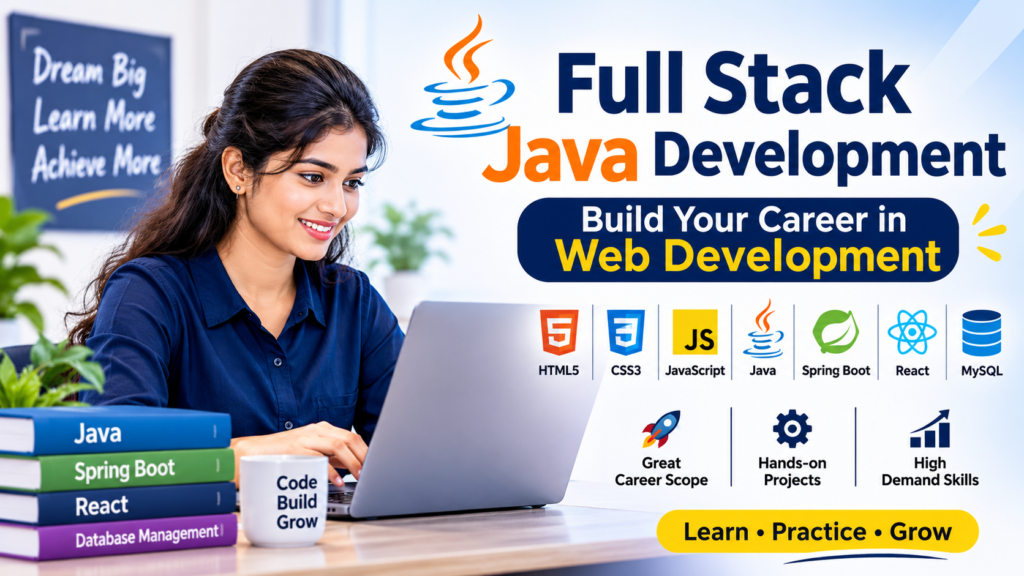
What Is Full Stack Java Development?
Full Stack Java Development is the process of creating complete web applications using Java for backend development along with frontend technologies such as HTML, CSS, and JavaScript.
A Full Stack Java Developer understands how different parts of an application work together. They can design web pages, develop application logic, connect databases, and manage server-side operations.
For example, when a customer logs into an online shopping website, the frontend displays the login page, while the backend checks the login details and retrieves the required information from the database.
Important Technologies Used in Full Stack Java Development
To become a Full Stack Java Developer, learners need to understand several technologies.
- HTML, CSS, and JavaScript
These are the basic technologies used in frontend development.
- HTML creates the structure of web pages.
- CSS controls the appearance, colours, layouts, and design.
- JavaScript adds interactive features to websites.
Together, these technologies help developers create attractive and responsive websites.
- Core Java
Java is an object-oriented programming language used to build different types of applications. Developers learn important concepts such as variables, data types, loops, methods, classes, objects, inheritance, and exception handling.
A strong understanding of Core Java makes it easier to develop backend applications.
- Advanced Java
Advanced Java introduces concepts used in enterprise and web application development. It includes JDBC, Servlets, and JSP. These technologies help applications communicate with databases and process user requests.
- Spring and Spring Boot
Spring is a popular Java framework used to develop powerful backend applications. Spring Boot makes application development easier by reducing configuration work and providing useful features for building standalone applications and REST APIs.
- Database Management
Every application needs a place to store information. Developers use databases such as MySQL to save and manage customer details, login information, product data, and transactions.
Learning SQL helps developers retrieve, update, insert, and delete database records.
- React and Frontend Frameworks
React is a JavaScript library used to create interactive user interfaces. It helps developers build reusable components and manage dynamic content in modern web applications.
Why Should You Learn Full Stack Java Development?
Full Stack Java Development offers a practical combination of programming and problem-solving skills.
1. Career Opportunities: Skilled developers can explore opportunities in software companies, IT organisations, startups, and other industries.
2. Complete Development Knowledge: You learn how both frontend and backend technologies work together.
3. Industry-Relevant Skills: Java, Spring Boot, SQL, and frontend technologies are useful in building real-world applications.
4. Project Development: You can create projects such as online shopping websites, student management systems, banking applications, and employee management portals.
5. Continuous Learning: As technology changes, developers can improve their knowledge by learning modern frameworks, cloud platforms, and development tools.
Career Opportunities After Full Stack Java Training
After gaining the required knowledge and practical experience, learners can explore different job roles, including:
- Full Stack Java Developer
- Java Backend Developer
- Java Software Developer
- Web Application Developer
- Junior Java Developer
- Software Engineer
The actual opportunities depend on programming knowledge, project experience, communication skills, and employer requirements.
How to Start Learning Full Stack Java Development?
If you are a beginner, start by understanding programming fundamentals. Practise Core Java before moving to advanced concepts. Next, learn HTML, CSS, JavaScript, database management, and Spring Boot.
Work on small projects while learning each technology. Once you understand the basics, try developing a complete web application that connects the frontend, backend, and database.
Practical experience is important because it helps you understand how software is developed in real working environments.
Conclusion
Full Stack Java Development is a valuable learning path for anyone interested in building modern web applications. It provides knowledge of frontend design, backend programming, database management, and application development. With regular practice, real-time projects, and continuous learning, beginners can develop the technical skills needed to explore opportunities in the software industry.
Choosing the right Full Stack Java training programme can also help learners understand industry tools and gain practical development experience.