
Software is part of almost everything we use today, from mobile applications and banking platforms to online shopping and healthcare services. Behind many of these systems are developers who understand both the front-end and back-end of an application.
This is where a Full Stack Java Course becomes valuable.
Instead of learning only one part of software development, full stack training helps learners understand how different technologies work together.
Whether you are a college student, a graduate, or someone planning a career change, gaining these practical skills can open the door to a wide range of opportunities in the IT industry.
What is a Full Stack Java Course?
A Full Stack Java Course teaches you how to build complete web applications from start to finish.
It covers everything from designing user interfaces to developing server-side applications and working with databases.
Rather than focusing only on programming theory, learners spend time creating projects that demonstrate how different technologies connect to solve real business problems.
This practical approach helps build confidence while improving problem-solving skills.
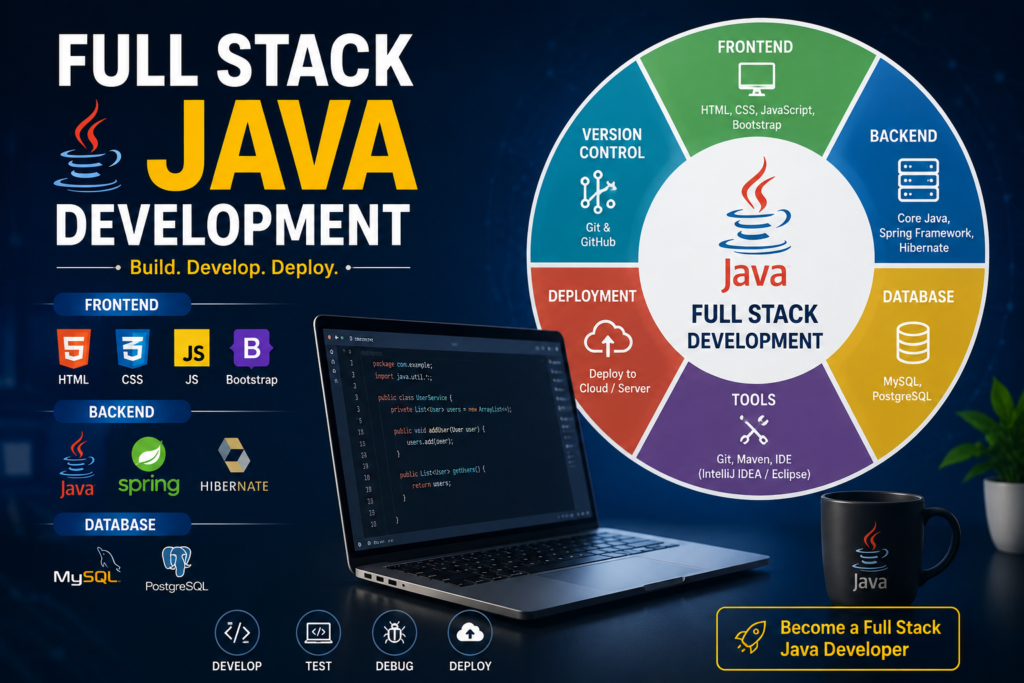
Topics You Can Learn in a Full Stack Java Course
A structured Full Stack Java Course usually includes:
Front-End Development
HTML
CSS
JavaScript
Bootstrap
Responsive Web Design
Back-End Development
Core Java
Advanced Java
Spring Framework
Spring Boot
REST APIs
Database Management
MySQL
SQL Queries
Database Design
CRUD Operations
Development Tools
Eclipse or IntelliJ IDEA
Git and GitHub
Maven
Postman
Working on projects using these tools helps learners understand the software development process in a practical way.
Who Can Join a Full Stack Java Course?
One of the strengths of a Full Stack Java Course is that it is suitable for people from different backgrounds.
It is a good choice for:
College students
Fresh graduates
Job seekers
Working professionals
Anyone interested in software development
Even beginners with little programming knowledge can gradually build their skills through regular practice and hands-on projects.
Career Opportunities After Learning Full Stack Java
Completing a Full Stack Java Course can prepare learners for different software development roles, including:
Full Stack Java Developer
Java Developer
Web Developer
Software Engineer
Back-End Developer
Front-End Developer
Application Developer
Technical Support Engineer
As businesses continue to build digital products and online services, professionals with practical Java development skills remain in demand across many industries.
Why Practical Learning Makes a Difference
Reading programming concepts is useful, but writing code regularly helps learners improve much faster. Working on small applications, debugging errors, and building complete projects develops confidence that cannot be gained through theory alone.
Many employers also value project experience because it demonstrates how a candidate applies technical knowledge to real situations. A portfolio of completed projects can make a resume stronger during job applications and interviews.
Why Practical Learning Makes a Difference
Technology continues to evolve, but Java remains one of the most trusted programming languages for enterprise applications, banking systems, e-commerce platforms, and large business solutions.
Developers who understand both front-end and back-end technologies are often able to work on a wider variety of projects. Continuing to learn new tools and frameworks alongside Java can help professionals stay competitive as the software industry grows.
Conclusion
A Full Stack Java Course is more than learning a programming language. It is an opportunity to understand how complete web applications are built, tested, and maintained. By combining technical knowledge with practical projects, learners develop skills that can support long-term career growth in software development.
With regular practice, curiosity, and consistent learning, today’s beginner can become tomorrow’s confident developer.
As technology continues to evolve, learning practical development skills becomes increasingly valuable. A strong understanding of Full Stack Java not only improves technical knowledge but also builds confidence to work on real-world projects. Continuous learning and regular practice can help learners stay prepared for future opportunities in the software industry.