
Flutter Development the mobile application industry is growing rapidly, and businesses are constantly searching for efficient ways to develop high-quality applications for different platforms. Traditionally, developers had to create separate applications for Android and iOS, which required different programming languages, development teams, and maintenance efforts. This process often increased both development time and project costs.
Flutter has completely changed this approach by introducing a powerful cross-platform development framework. Developed by Google, Flutter allows developers to create applications for Android, iOS, web, desktop, and even embedded devices using a single codebase. Its flexibility, excellent performance, and beautiful user interface capabilities have made it one of the most popular technologies in the software development industry.
What is Flutter?
Flutter is an open-source Software Development Kit (SDK) developed by Google for creating cross-platform applications. It uses the Dart programming language, which is easy to learn and designed for building fast applications. Unlike many other frameworks that rely on native UI components, Flutter uses its own rendering engine and customizable widgets. This enables developers to create applications with a consistent look and feel across different platforms.
Why Flutter is Becoming So Popular
Flutter has become one of the fastest-growing frameworks because it helps developers build applications efficiently without compromising quality. Instead of maintaining two different codebases for Android and iOS, developers can write code once and deploy it across multiple platforms.
Flutter Development businesses also benefit from lower development costs, faster project completion, and easier application maintenance. Updates and new features can be implemented quickly, reducing the overall development lifecycle.
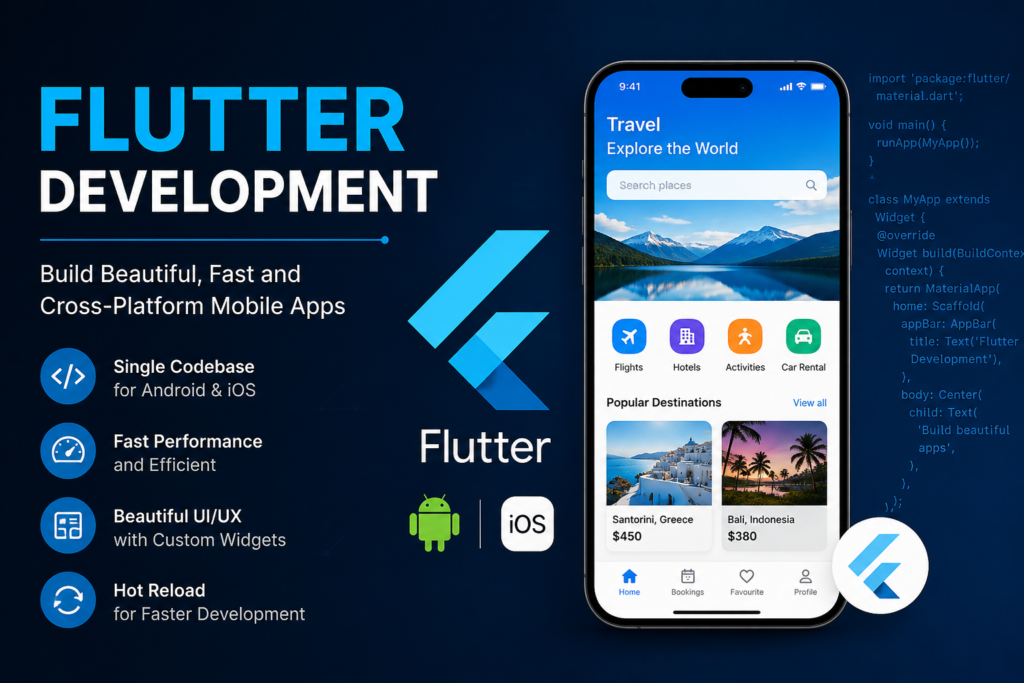
Key Features of Flutter Development
Single Codebase
Flutter Development enables developers to build applications for multiple platforms using one codebase. This reduces duplication of work and makes future maintenance much simpler.
Hot Reload
One of Flutter’s most appreciated features is Hot Reload. Developers can instantly view code changes without restarting the application. This significantly speeds up development, debugging, and testing.
Beautiful User Interface
Flutter Development provides a rich collection of customizable widgets that help developers create attractive and responsive interfaces. Applications maintain a consistent appearance regardless of the device or operating system.
Excellent Performance
Unlike many cross-platform frameworks, Flutter compiles directly into native machine code. This provides fast application startup, smooth animations, and responsive performance that closely matches native applications.
Strong Community Support
Flutter Development has a large global community of developers who continuously contribute plugins, libraries, tutorials, and development tools. This makes solving technical challenges much easier and accelerates project development.
Advantages of Flutter for Businesses
Businesses prefer Flutter because it helps reduce development expenses while maintaining excellent application quality. Since only one development team is required for multiple platforms, project costs decrease considerably.
Flutter also shortens the time required to launch products into the market. Businesses can introduce new features faster, respond to customer feedback more efficiently, and stay competitive in rapidly changing industries.
Applications Built with Flutter
Flutter is flexible enough to support different types of software applications across multiple industries. Some common applications include:
- E-commerce mobile applications
- Food delivery platforms
- Online learning applications
- Banking and financial applications
- Healthcare management systems
- Social networking applications
- Travel and booking platforms
- Business management software
- Entertainment and streaming applications
- Inventory management systems Career Opportunities in Flutter Development
The demand for Flutter developers has increased significantly over the past few years. Companies worldwide are investing in cross-platform mobile application development to reduce costs and improve efficiency.
Learning Flutter opens opportunities for careers such as Mobile Application Developer, Flutter Developer, Software Engineer, UI Developer, and Full Stack Developer. Freelancers also benefit because Flutter projects are in high demand on global freelancing platforms.
Best Practices for Flutter Development
Developers should follow coding standards and organize their projects effectively to build scalable applications. Using proper state management techniques, writing reusable widgets, testing applications regularly, and optimizing performance contribute to creating reliable software.
Future of Flutter
Flutter continues to evolve with regular updates from Google. As more businesses adopt cross-platform development, Flutter’s popularity is expected to grow even further. Its expanding ecosystem, improved desktop and web support, and strong developer community indicate a promising future.
Conclusion
Flutter has revolutionized mobile application development by enabling developers to build high-performance applications using a single codebase. Its combination of speed, flexibility, beautiful user interfaces, and native-like performance makes it an ideal choice for businesses and developers alike.
Whether you are creating an e-commerce application, educational platform, healthcare solution, or enterprise software, Flutter provides the tools needed to deliver exceptional user experiences across multiple platforms. Learning Flutter not only improves development efficiency but also opens exciting career opportunities in today’s competitive software industry. As the demand for cross-platform applications continues to rise, mastering Flutter is a smart investment for anyone looking to succeed in modern software development.