
The Real Question Everyone Is Asking in 2026
Every year, new technologies enter the market. New programming languages emerge. Artificial Intelligence becomes more powerful. Automation tools grow smarter. Because of this constant innovation, many students and working professionals begin to question whether certain careers are still stable.
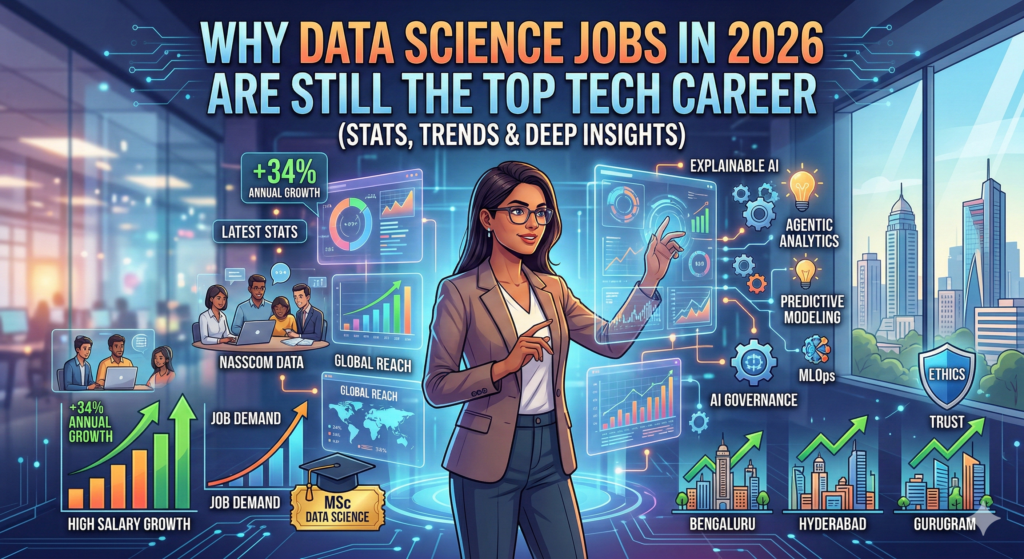
One such career that consistently sparks debate is data science.
So let’s address the real question directly are Data Science Jobs in 2026 still the top tech career choice?
The answer is not based on hype. It is based on industry demand, salary growth, business transformation trends, and global digital expansion. Data science is no longer just a technical field; it has become a strategic business necessity. Organizations today cannot compete without using data to make intelligent decisions. And that reality is exactly why this career continues to dominate the tech industry landscape.
The Explosion of Data and Why It Matters More Than Ever
We are living in a data-driven era. Every click, transaction, medical record, online purchase, social media interaction, GPS signal, and digital footprint generates data. Businesses collect structured and unstructured information at massive scale. However, data by itself is meaningless unless someone can interpret it.
This is where the importance of Data Science Jobs in 2026 becomes clear.
Companies do not simply need storage systems. They need professionals who can clean raw datasets, analyze behavioral patterns, build predictive models, and transform numbers into actionable insights. From forecasting sales to detecting fraud and optimizing logistics, data science has become deeply integrated into decision-making processes.
The volume of global data continues to grow exponentially each year. As this growth continues, the demand for skilled professionals capable of extracting business intelligence from data also increases. This is not a temporary trend — it is a structural shift in how organizations operate.
Why Businesses Continue Investing in Data Science in 2026
Businesses today compete in highly dynamic markets. Consumer behavior changes rapidly. Market conditions fluctuate. Economic uncertainties affect planning. In such an environment, guesswork is risky and expensive.
Data science reduces uncertainty.
Organizations use analytics to predict demand, understand customer preferences, personalize marketing campaigns, improve product design, manage risks, and enhance operational efficiency. These applications are not experimental anymore — they are essential.
Because of this, Data Science Jobs in 2026 are not considered optional hires. They are strategic roles that directly influence profitability and growth. Companies recognize that investing in data professionals leads to measurable business outcomes.
Furthermore, industries that were once slow to adopt technology — such as agriculture, manufacturing, education, and public services — are now integrating analytics into their systems. This expansion across sectors ensures that opportunities remain diverse and sustainable.
Salary Growth and Career Stability in Data Science
One of the strongest indicators of a career’s relevance is compensation growth. High salaries reflect high demand and business value.
Data science continues to offer competitive salary structures across experience levels. Entry-level professionals in analytics and junior data science roles already receive attractive packages compared to many traditional IT positions. As professionals gain experience in machine learning, cloud platforms, big data tools, and AI integration, salary progression becomes significant.
The reason salaries remain strong is simple. Data professionals create measurable impact. Their work influences revenue growth, cost reduction, risk mitigation, and strategic planning. When a role directly affects business performance, organizations are willing to invest more.
In addition to salary growth, career mobility within the field is another advantage. Professionals can transition into specialized roles such as machine learning engineering, data engineering, AI system design, analytics consulting, or even leadership positions. This flexibility adds long-term stability to Data Science Jobs in 2026.
Artificial Intelligence and Its Relationship with Data Science
A common concern in recent years has been whether artificial intelligence will replace data scientists. With the rapid advancement of automation tools and generative AI platforms, this concern appears logical at first glance.
However, the relationship between AI and data science is collaborative, not competitive.
Artificial intelligence systems require structured data, model training, validation, monitoring, and optimization. Data scientists and machine learning engineers play a crucial role in preparing datasets, designing algorithms, and ensuring model accuracy. AI tools may automate repetitive tasks, but strategic thinking, interpretation, and ethical oversight still require human expertise.
In fact, AI adoption has increased the complexity of systems, thereby expanding the scope of Data Science Jobs in 2026. Instead of replacing professionals, technology has elevated their responsibilities to more strategic and impactful levels.
Emerging Roles Expanding the Scope of Data Science Jobs in 2026
The field of data science is no longer limited to a single job title. Over time, it has evolved into a broad ecosystem of specialized roles.
Organizations now hire professionals in areas such as data engineering, machine learning operations, AI system deployment, business intelligence analysis, and ethical AI governance. Each role focuses on a specific aspect of the data lifecycle, from data collection and transformation to modeling and performance optimization.
This diversification is a positive sign. It shows that the industry is maturing and expanding. For students and professionals, it means multiple entry points exist depending on strengths and interests.
Because of this structural expansion, Data Science Jobs in 2026 offer not just employment but long-term career pathways.
Skills That Define Success in Data Science
While demand remains strong, competition has also increased. To succeed in this field, professionals must develop both technical and analytical capabilities.
Technical skills such as programming, database management, and machine learning fundamentals remain essential. Knowledge of statistical concepts allows professionals to interpret data accurately. Familiarity with visualization tools helps communicate findings effectively.
However, technical ability alone is not enough.
Organizations value professionals who understand business objectives. The ability to connect analytical results with strategic decisions differentiates average professionals from exceptional ones. Communication skills, critical thinking, and problem-solving abilities are equally important.
As businesses prioritize impact over complexity, professionals who can simplify insights and guide decision-making will thrive in Data Science Jobs in 2026.
The Global Demand and Remote Opportunities
Another reason data science remains attractive is its global relevance. Unlike location-specific careers, data science skills are transferable across industries and countries.
Remote work culture has expanded opportunities further. Many organizations now hire talent regardless of geographical boundaries. This allows skilled professionals to work with international clients and global companies without relocation.
This global integration strengthens the position of Data Science Jobs in 2026 as one of the most flexible and scalable tech careers.
Is Data Science Still a Smart Choice for Students in 2026?
For students evaluating career options, data science continues to offer strong potential. The field encourages continuous learning and adaptability. It provides exposure to multiple domains including finance, healthcare, marketing, technology, and research.
Unlike some specialized roles that may become outdated, data science adapts with technological evolution. As new tools emerge, professionals update their skills. This adaptability ensures long-term career sustainability.
Students from diverse academic backgrounds can enter this field with structured learning and practical exposure. With consistent practice, project development, and portfolio building, entry into the industry remains achievable.
Why Data Science Jobs in 2026 Are Considered Future-Proof
Future-proof careers align with long-term technological and economic trends. Data science aligns with digital transformation, automation, AI integration, and cloud computing expansion.
Businesses will continue generating data. They will continue needing insights. They will continue optimizing operations. As long as these realities exist, the demand for data professionals will remain stable.
The field may evolve. Tools may change. Algorithms may improve. But the core function of extracting meaningful insights from data will always be relevant.
That is why Data Science Jobs in 2026 are not just trending — they are foundational to modern business infrastructure.
Final Conclusion: The Strategic Advantage of Choosing Data Science
When evaluating career choices, it is important to look beyond temporary trends. Sustainable careers are built on structural industry demand and long-term relevance.
Data science fulfills both criteria.
It offers strong salary potential, diverse industry applications, global mobility, technological alignment, and continuous learning opportunities. Organizations increasingly depend on data-driven strategies, making skilled professionals indispensable.
For anyone considering a technology career path, Data Science Jobs in 2026 remain one of the most reliable and strategically advantageous options available.
Your Career Decision Starts Today
If you are serious about entering a high-growth technology field, this is the right time to act.
Start building foundational skills.
Practice real-world problem solving.
Develop analytical thinking.
Stay updated with emerging AI trends.
The opportunities within Data Science Jobs in 2026 are not limited to experts alone. They are available to those who commit to structured learning and consistent improvement.
Your future in data science does not begin tomorrow.
It begins with the decision you make today.